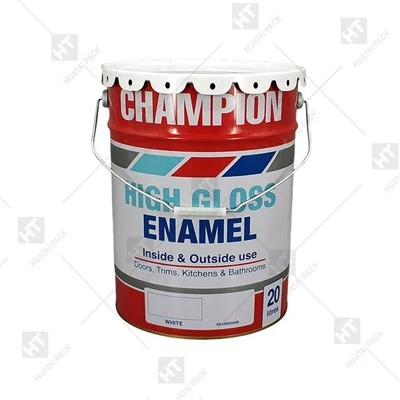


How to judge the quality of a paint can
Jul 20, 2026
1. Appearance and Sealing Inspection
High-quality cans have a smooth, undeformed, rust-free, and burr-free surface. Welds are uniform and smooth, and the can opening and lid fit tightly. They should not leak when inverted and shaken. Inferior cans are prone to incomplete welds, deformed openings, and poor solvent resistance in the sealing rings, leading to leakage and material seepage after use.
2. Material Performance Verification
Tinplate Cans: Use food-grade/industrial-grade tin-plated sheet with a wall thickness ≥0.6mm. The inner coating should be uniform and without peeling. Long-term contact with oil-based paints should not cause swelling or corrosion.
Plastic Cans: Use brand-new HDPE virgin material. They should have no pungent odor, withstand temperatures ≥60℃, and show no swelling or cracking after a 24-hour solvent immersion test.
Stainless Steel Cans: 304/316 stainless steel is preferred. The wall thickness should be uniform, free of pinholes, and suitable for use with highly corrosive special coatings.
3. Compliance and Labeling Verification
Qualified cans must be fully labeled with registered trademarks, manufacturer's name and address, applicable standard number, shelf life, etc. Cans used in flammable and explosive environments must have UN antistatic and explosion-proof certifications. Inferior cans often have unclear labeling and lack compliance test reports, posing safety hazards.
4. Practical Performance Testing
After filling with the corresponding coating, allow the can to stand for 24 hours. Observe for any deformation or leakage. After opening the lid, there should be no abnormal leaching. Cans used for pressurized spraying must undergo a pressure resistance test. Under the rated working pressure, there should be no bulging or cracking, ensuring safe production and use.