

What is the heat conductivity of a closed metal pail?
Dec 22, 2025
Hey there! As a supplier of closed metal pails, I often get asked about the heat conductivity of these nifty containers. It's a pretty interesting topic, and I'm excited to share what I know with you.
Let's start with the basics. Heat conductivity, also known as thermal conductivity, is a measure of how well a material can transfer heat. When it comes to closed metal pails, understanding their heat conductivity is crucial for a variety of applications. Whether you're using them to store hot liquids, transport substances that need to maintain a specific temperature, or even in industrial processes where heat management is key, the heat conductivity of the metal pail plays a significant role.
Now, the heat conductivity of a closed metal pail depends mainly on two things: the type of metal used and the thickness of the metal walls. Different metals have different heat - conducting properties. For example, aluminum is a great conductor of heat. It has a relatively high thermal conductivity, which means it can transfer heat quickly. If you have a closed metal pail made of aluminum, it will heat up and cool down rapidly when exposed to different temperatures. This property can be beneficial in some situations where you need quick heat exchange, like in certain cooling or heating processes.
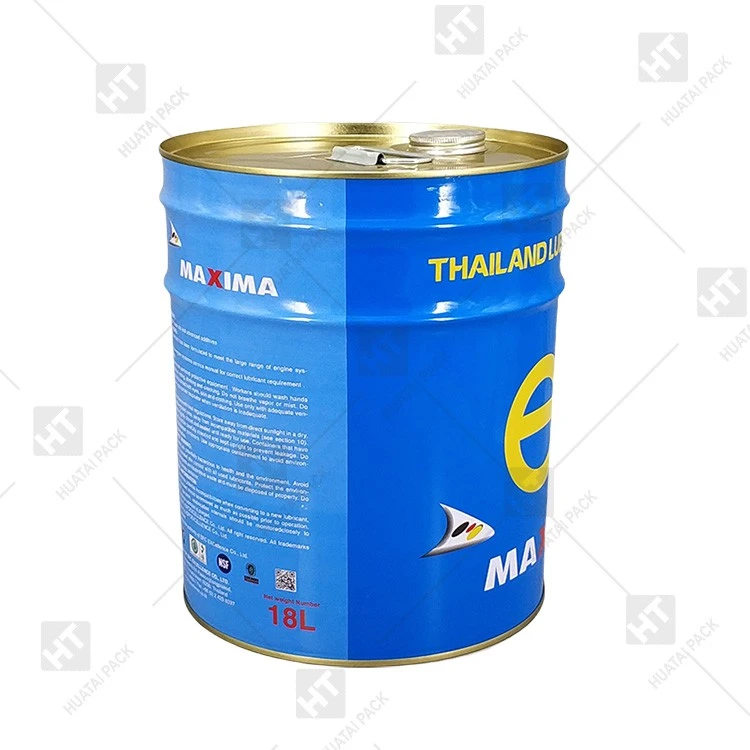
On the other hand, steel is another commonly used metal for closed metal pails. While steel also conducts heat, its thermal conductivity is lower than that of aluminum. So, a steel closed metal pail will heat up and cool down more slowly compared to an aluminum one. This can be an advantage if you want to maintain the temperature of the contents inside the pail for a longer period. For instance, if you're storing hot engine oil in a Metal Drum For Engine Oil, a steel drum can help keep the oil warm for a while.
The thickness of the metal walls of the pail also affects heat conductivity. Thicker walls mean that there is more material for the heat to pass through. This generally slows down the heat transfer process. A closed metal pail with thick walls will act as better insulation compared to one with thin walls. Let's say you have two 5 - gallon metal pails, one with a thin aluminum wall and another with a thick aluminum wall. The thin - walled pail will transfer heat more quickly because there is less material to impede the heat flow. The thick - walled pail, however, will hold the heat inside for a longer time, making it suitable for applications where temperature stability is essential.
So, why is all this important for you as a potential buyer? Well, depending on your specific needs, the heat conductivity of the closed metal pail can make or break your product use. If you're in a business where you need to quickly heat or cool the contents of the pail, like in a chemical reaction process where temperature control is critical, you might opt for a pail made of a highly conductive metal with thinner walls. For example, some chemical laboratories use 5gallon Metal Pail made of aluminum with relatively thin walls to quickly adjust the temperature of their chemical solutions.
On the contrary, if you're looking to store substances that need to stay at a consistent temperature for a long time, such as food products or temperature - sensitive liquids, a pail made of a less - conductive metal with thicker walls would be a better choice. A lot of food suppliers use Closed Metal Pail made of steel with thick walls to keep their products fresh and at the right temperature during storage and transportation.
It's also worth noting that the design of the closed metal pail can have an impact on heat conductivity. For example, if the pail has a tight - fitting lid, it can reduce heat loss through convection. Convection is the transfer of heat through the movement of fluids (like air or liquid). A well - sealed lid can prevent warm air from escaping and cold air from entering, thus helping to maintain the temperature inside the pail. Additionally, some pails may have insulation layers added to them. These insulation layers can significantly reduce the overall heat transfer rate, making the pail even better at keeping the contents at a stable temperature.
When choosing a closed metal pail, you should also consider the environment in which it will be used. If the pail will be exposed to extreme temperatures, whether hot or cold, the heat conductivity properties become even more critical. For example, if you're using the pail in a very cold climate to store a liquid that shouldn't freeze, you'll need a pail that can retain heat well. In a hot environment, a pail with good heat - dissipation properties might be more suitable to prevent the contents from overheating.
As a supplier, I've seen firsthand how the right choice of a closed metal pail based on its heat conductivity can make a big difference in various industries. Whether it's in the food and beverage industry, the chemical sector, or for industrial storage purposes, understanding the heat conductivity of these pails is essential for making informed decisions.

If you're in the market for closed metal pails and are unsure which one would be best for your needs, don't hesitate to reach out for a chat. We can discuss your specific requirements, such as the type of substance you'll be storing, the temperature conditions it will be exposed to, and your budget. Based on this information, I can help you select the perfect closed metal pail that offers the ideal heat conductivity for your application.
Contact us to start the conversation and let's find the best closed metal pail solution for you!
References
- "Thermodynamics of Materials" by David R. Gaskell
- "Engineering Heat Transfer" by J. P. Holman