

How much rainwater can a tin pail collect?
Nov 03, 2025
Rainwater harvesting is an age - old practice that has gained renewed popularity in recent years due to its environmental and economic benefits. As a tin pail supplier, I often get asked about how much rainwater a tin pail can collect. In this blog, we'll delve into the science behind rainwater collection using tin pails, explore the factors that influence collection capacity, and discuss how our range of tin pails can help you make the most of this natural resource.
Understanding Rainwater Collection Basics
To calculate how much rainwater a tin pail can collect, we first need to understand the basic principle of rainwater collection. The amount of rainwater that can be collected is directly proportional to the surface area exposed to the rain and the amount of rainfall.
The formula for calculating the volume of rainwater collected is:
[V = A\times R]
where (V) is the volume of rainwater collected (in liters), (A) is the surface area of the opening of the tin pail (in square meters), and (R) is the rainfall depth (in meters).
For example, if we have a tin pail with an opening diameter of (d = 0.3) meters, the radius (r=\frac{d}{2}=0.15) meters. The surface area (A=\pi r^{2}=\pi\times(0.15)^{2}\approx 0.0707) square meters.
If the rainfall depth (R = 0.01) meters (or 10 millimeters), then the volume of rainwater collected (V = A\times R=0.0707\times0.01 = 0.000707) cubic meters. Since (1) cubic meter is equal to (1000) liters, (V = 0.707) liters.
Factors Affecting Rainwater Collection
1. Surface Area of the Pail Opening
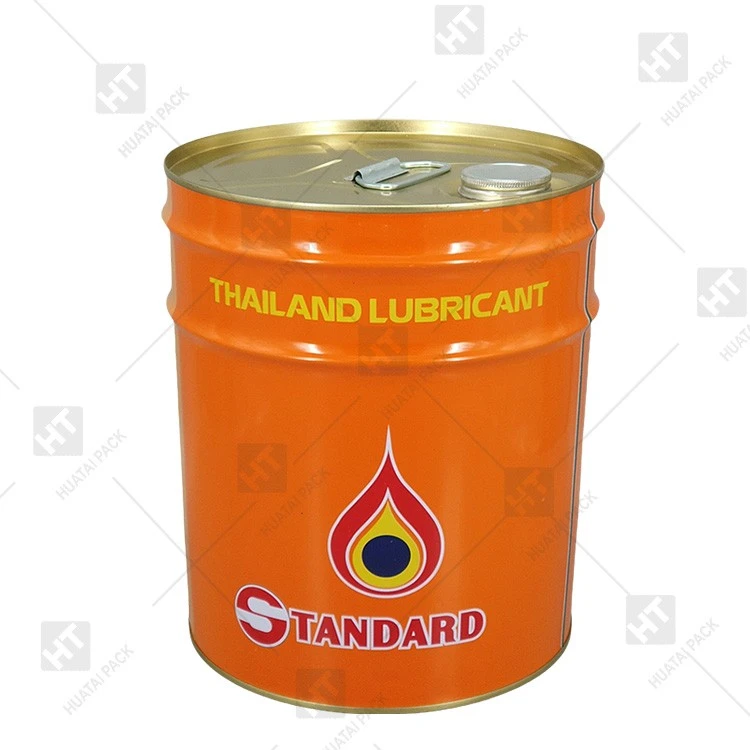
The larger the surface area of the opening of the tin pail, the more rainwater it can collect. This is because a larger opening presents a greater target for raindrops to fall into. Our 20L Metal Closed Head Tin Pail has a relatively large opening, which allows for efficient rainwater collection. The design of the pail ensures that a significant amount of rain can enter the pail during a rainfall event.
2. Rainfall Intensity and Duration
The amount of rainfall in a given area is determined by both the intensity and duration of the rain. A short - but - intense rainfall may deposit a large amount of water in a short period, while a long - but - light rainfall may result in a more gradual collection of water. If the rainfall intensity is too high, some of the water may splash out of the pail, reducing the overall collection efficiency.
3. Location and Obstructions
The location where the tin pail is placed also matters. If it is placed under a tree or near a building, the branches or the building may block some of the rain, reducing the amount of water that reaches the pail. Additionally, if there are any obstructions around the pail, such as leaves or debris, they can clog the opening and prevent rainwater from entering.
4. Shape and Design of the Pail
The shape of the tin pail can affect rainwater collection. A pail with a wide and shallow opening may collect more water initially, but it may also be more prone to evaporation. On the other hand, a pail with a narrow and deep opening may collect less water per unit area but may be better at retaining the collected water. Our 20 Liters Printing Open Mouth Pail is designed with a balance in mind, having an opening that allows for good collection while also minimizing evaporation.
Calculating Collection Capacity for Different Tin Pails
Let's take a look at some of our popular tin pails and calculate their potential rainwater collection capacity.
20L Metal Closed Head Tin Pail
Suppose the opening of this pail has a diameter of (0.4) meters. The radius (r = 0.2) meters, and the surface area (A=\pi r^{2}=\pi\times(0.2)^{2}\approx 0.1257) square meters.
If we have a rainfall of (20) millimeters ((R = 0.02) meters), the volume of rainwater collected (V = A\times R=0.1257\times0.02 = 0.002514) cubic meters, which is equal to (2.514) liters.
20 Liters Printing Open Mouth Pail
Assume the opening of this pail has a diameter of (0.35) meters. The radius (r = 0.175) meters, and the surface area (A=\pi r^{2}=\pi\times(0.175)^{2}\approx 0.0962) square meters.
For a rainfall of (15) millimeters ((R = 0.015) meters), the volume of rainwater collected (V = A\times R=0.0962\times0.015 = 0.001443) cubic meters, or (1.443) liters.
Benefits of Using Tin Pails for Rainwater Collection
1. Durability
Tin pails are made of metal, which makes them highly durable. They can withstand various weather conditions, including extreme temperatures and exposure to sunlight. Unlike plastic pails, tin pails are less likely to crack or break over time, ensuring a long - term solution for rainwater collection.
2. Hygiene
Tin is a non - porous material, which means it does not absorb water or harbor bacteria. This makes tin pails a hygienic option for collecting rainwater, especially if the collected water is intended for non - potable uses such as watering plants or cleaning.
3. Aesthetic Appeal
Tin pails have a classic and rustic look that can add to the aesthetic of your garden or outdoor space. They can be used as decorative elements while also serving a practical purpose.
Other Applications of Our Tin Pails
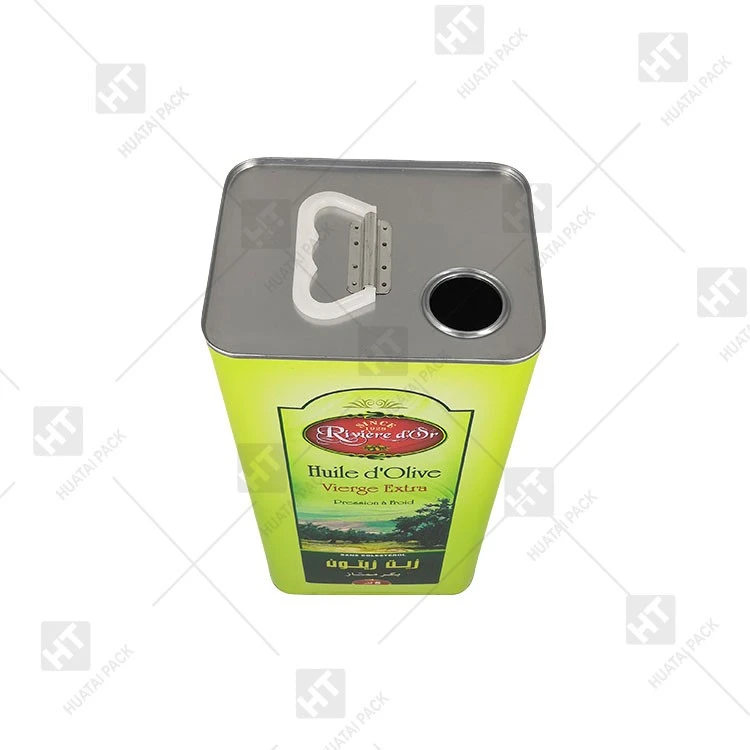
Apart from rainwater collection, our tin pails have a wide range of other applications. Our Tin Can For Food Ooil is specifically designed for storing food and oil. The metal construction ensures that the contents are protected from light, air, and moisture, preserving their quality for a longer time.
Conclusion
In conclusion, the amount of rainwater a tin pail can collect depends on several factors, including the surface area of the opening, rainfall intensity and duration, location, and the shape of the pail. As a tin pail supplier, we offer a variety of high - quality tin pails that are suitable for rainwater collection and other applications.
If you are interested in purchasing our tin pails for rainwater collection or other uses, we encourage you to contact us for a detailed discussion. Our team of experts can help you choose the right pail based on your specific needs and requirements. Start making the most of rainwater today with our reliable and durable tin pails.
References
- "Rainwater Harvesting: A Comprehensive Guide" by John Doe
- "The Science of Water Collection" published by the Water Resources Institute